August 22, 2026
Mastering for Radio Play: What Survives the Broadcast Chain
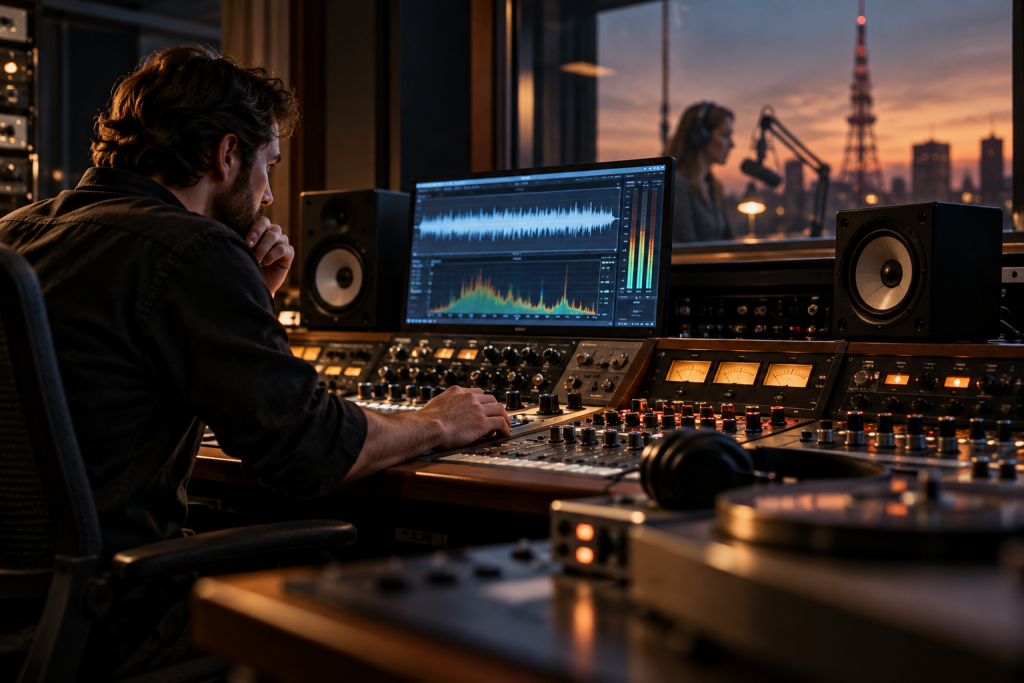
I spent years programming an internet radio station, and the most useful lesson came from a cheap car radio in the parking lot. A mix I’d spent a week balancing sounded like a wall of mush through those speakers. That’s the honest test: not how a track sounds on your monitors, but what’s still there after the broadcast chain has chewed it up and spat it out at 128 kbps into a five-year-old car stereo.
Streaming data rates get the attention, but the compression and limiting that radio itself applies, plus the codec, plus the listener’s hardware, is where careful mastering earns its keep. If you’re prepping material for a station, a playlist that plays in long stretches, or any broadcast context, here’s what actually survives and what quietly falls apart.
The chain is not your friend
Mastering is the step where the stereo mixdown gets refined to translate across playback systems, according to the standard definition of the process. Broadcast adds another layer most people never hear in the studio. A station’s processing stack typically re-compresses and re-limits everything to keep levels even across a day of programming. So your master isn’t the final word. It’s an input, and it’s feeding a processor that assumes you didn’t already crush everything to the ceiling.
That’s the core mistake I hear in submissions. People master loud for Spotify, hand the same file to radio, and the station’s limiter does the rest. The result: the quiet parts get pulled up, the loud parts get pushed down, and whatever contrast you built into the arrangement turns into a flat, fatiguing slab. As one mastering breakdown puts it, pushing too hard kills the dynamics and makes a track sound fatiguing. Keep the loudness, by all means, but leave the mix some headroom to move.
That tension is not new. It’s just worse on radio, where the processing is out of your hands.
What survives, in order
Think about what the chain can’t touch.
Arrangement and space. A mix with actual gaps and separation survives heavy processing. A mix where every element is fighting for the same midrange does not. If two instruments occupy the same frequency band and neither is clearly louder, compression will only smear them together further. This is a mix decision, not a mastering one, and no plugin chain fixes it at the end.
Low-end discipline. Small speakers and codecs throw away or mangle sub content. A boomy, undefined low end becomes a muddy thump. Tight, mid-focused bass information translates. This is where gentle high-pass work and honest low-mid control pay off, the same kind of moves that keep a long playlist coherent.
Vocal intelligibility. On a car radio or a phone speaker, the voice is the thing listeners track. If the vocal sits too low in the mix or competes with a harsh cymbal or a mid-heavy synth, it disappears. Presence and a clear midrange carry the message.
True dynamic contrast. The verse-to-chorus jump is what makes a track feel alive over the air. Master it into a flat brick and you’ve deleted the one thing that tells a listener “this is the good part.”
The tools, and what they’re actually for
EQ in mastering is a tonal sculptor, used gently to fix lingering balance issues rather than to redesign a mix. Small moves. If the bass is a touch boomy or the highs are slightly harsh, you nudge. Drastic EQ at the mastering stage usually means going back to the mix.
Dynamic range compression is the other core tool, used to optimize translation across systems. On radio-bound material, the instinct to over-compress is the enemy. Your compression should be doing less than you think, because the broadcast chain will add more. Leave headroom. That single discipline gives the station’s processor room to work without flattening everything.
The finishing tools deserve skepticism. Saturation can add harmonic richness and warmth, and a little of it can make a thin track feel more “finished.” But harmonic content also fills the spectrum, and on a lossy stream, more harmonics can mean more codec artifacts. Stereo imaging is the riskier one: widening needs extreme care to avoid phase issues, and phase problems that sound subtle on monitors can collapse a mix to mono on a cheap radio or a phone. If a station sums your track, an over-widened mix goes hollow.
Order matters too, though it’s less mystical than people make it sound. The common flow is corrective EQ, then compression, then any color or saturation, then limiting last. That’s a sensible default, not a law.
Length and structure over the air
Here’s the part that has nothing to do with plugins. Radio editors generally cut anything over four minutes unless you’re already a known name. A tight, impactful track gets replayed, and replays mean exposure. Keep intros under about fifteen seconds unless the genre is genuinely cinematic or ambient. Don’t lean on repetition past the point where the best chorus wears out. The bridge should add contrast, not confusion, and an outro that adds nothing should get cut.
All of that survives the chain because it’s arrangement and editing, not processing. A great three-minute thirty track will translate better than a sprawling six-minute one every time, because there’s less material for the codec and the limiter to fumble, and the listener’s attention never drifts.
What doesn’t survive
A louder master does not rescue a weak arrangement. It makes the problems easier to hear. This is the same trap people fall into with AI-generated material: mastering makes a track loud, compliant, and tonally balanced, and every underlying flaw is still there. Processing is finishing, not rescue.
Over-limiting. Brickwall loudness sounds impressive solo on streaming services and turns to mush on air.
Over-widening. It can sound huge in headphones and phase into nothing on a mono radio feed.
And chasing perfection for one platform. A master tuned to translate across every streaming service and device, as the standard mastering advice puts it, will also hold up on radio. Tune for translation, not for a specific number. The station’s processor will do its own thing regardless.
My working approach
For broadcast and long-mix material, I master quieter than the streaming target. I leave real headroom, keep the limiting gentle, and check every master through a mono sum and a small speaker before it leaves the room. I refuse to widen anything that matters.
Then I listen in the car. That’s still the most honest broadcast chain I own, and it has saved more mixes than any meter. If the vocal is clear, the low end isn’t a smear, and the chorus still jumps when the processing squeezes it, you’ve done the job. If it doesn’t, no limiter is going to fix it at the end of the chain.