November 1, 2026
Picking a Limiter That Won’t Wreck a Whole Set: Three Tested on Long Playback
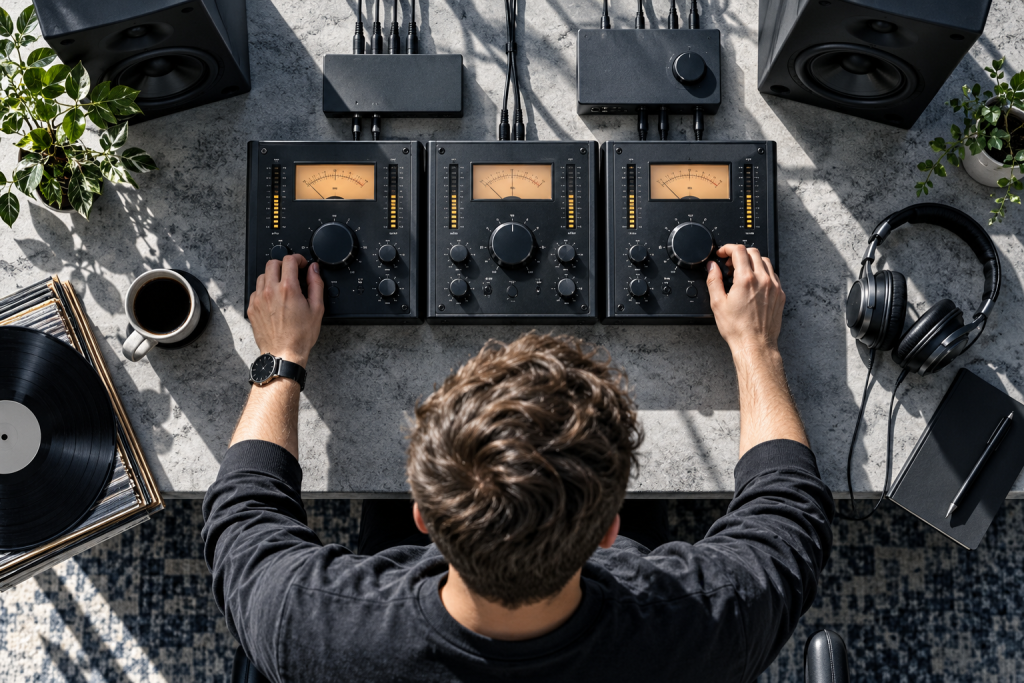
Two hours is a different animal from three minutes. A master that sounds open and punchy on a single track can turn into a flat, tiring wall by track nine, and by the end of a show the listener has quietly stopped paying attention. We judge limiters the way a radio programmer judges a set: not by the loudest bar, but by whether it holds up across the whole shift.
Here are three we ran over full-length playback, with notes on what each one does to a long set and who should walk away from it.
Why a single-pass demo tells you almost nothing
A limiter is asked to do one job over and over: catch the peaks without leaving a fingerprint the ear can learn. On a short loop you will not hear the fingerprint. Over ninety minutes you will. Small amounts of pumping, or distortion on transients, that pass unnoticed on one chorus become a texture the listener registers as fatigue. That is the thing we are actually testing for.
So the tests dropped each limiter into the same chain, same source material, and ran it long. We kept gain reduction where the guidance puts it, around 3 to 4 dB, and paid attention to whether the reduction stayed stable or wandered as the material changed. A limiter that has to be re-tweaked between tracks is not a limiter for a set; it is a limiter for a single master.
Method, briefly
Real peak limiting first. Inter-sample peaks cause clipping on playback systems, so true peak handling is not optional if you care about what comes out the other end, per the recordmixandmaster chain notes. Every candidate here was set to respect true peak, and we compared them at matched loudness rather than matched settings. Matched loudness is the only fair test; a limiter that wins by being louder has not won anything.
Second variable: the clipper before the limiter. Run a clipper on the master to shave 2 to 4 dB off the transients and the limiter does not get slammed nearly as hard, which the Studio One forum thread found gave a cleaner result. We tested each limiter both with and without that pre-clip, because how a limiter behaves when it is not working alone matters more than its solo sound.
FabFilter Pro-L 2
The one we keep coming back to for long playback. Its transparency is the headline; on the modern setting we got clean limiting with very little of the grabby quality that shows up late in a set. Push it and it still tells you what it is doing, which is more than a lot of limiters that hide their work until the eighth track.
What it costs you is control. There are a lot of options, and the wrong combination of style and lookahead can introduce exactly the pumping the pre-clip was supposed to prevent. It rewards the engineer who understands the chain around it. If you set it and leave it without matching it to the material, you will hear the mismatch over time.
Verdict for a set: the safest default. Transparent enough that two hours does not wear on the ear.
UAD 1176 (the Collection)
A different tool. The 1176 is character and aggression, not a transparent peak-minder. The three revisions each behave differently. The Bluestripe is prized for its distortion and its bite on drums. The low-noise Revision E is the one that gives you a more transparent reduction. The Anniversary Edition runs lower ratios for subtler gain reduction.
As a mastering limiter for an entire show, the 1176 is the wrong instinct. It colors, and color repeated across a whole set becomes a house sound the listener did not ask for. But it is excellent as the second limiter in a stack, or as the character layer when a single track needs attitude. Used alone on a full playback it will impose its opinion on everything, and by the end you will notice.
Verdict for a set: superb for one track with a point of view, not the one to trust across ninety minutes of someone else’s music.
SSL Bus Compressor emulations
Not strictly a limiter, and we are including it because the chain order confuses people. The SSL bus compressor comes in versions from SSL themselves, Waves, IK, Slate, Universal Audio, Cytomic and others, and the punchy, cohesive character is the appeal. It is a glue tool. Put it early, let it do its 1 to 2 dB of gentle compression, and let a true limiter handle the last 2 to 3 dB.
Treated as the final limiter, it pumps and it colors in a way that compounds over a long set. Treated as the compressor it is, it is one of the more reliable pieces in a chain and the reason two limiter stages can sound better than one.
Verdict for a set: glue, not peak control. Do not ask it to be the last thing in the chain.
The two-stage habit
The single most reliable improvement we made had nothing to do with choosing between these three. It was splitting the work. Put a clipper or a compressor up front to deal with the obvious peaks, then let the limiter do less. The recordmixandmaster chain advice lands in the same place: keep the limiter light, around 3 to 4 dB, and watch what it does to transients and dynamics.
When we removed the clipper and tried to compensate with the limiter alone, level-matched, we got the pumping and distortion the forum thread warned about. The limiter was being asked to do a job the clipper does better. Over a long set that difference is not subtle. It is the difference between a show that holds and one that sags.
What we would actually do
For a full evening of playback, the FabFilter Pro-L 2 in modern mode is the one we reach for first. Set true peak, keep the reduction modest, and put a little pre-clipping ahead of it so the limiter is not slamming. Reach for the 1176 when a single track needs a character the set can support, and keep an SSL-style compressor doing the glue work earlier in the chain.
None of these will save a set that is badly arranged. The listener does not forgive a limiter doing too much just because it is a good limiter. But pick one that stays out of the way over two hours, and the show holds. That is the whole job.