November 2, 2026
Mapping a Twelve Hour Rotation: How to Keep Loudness Steady Overnight
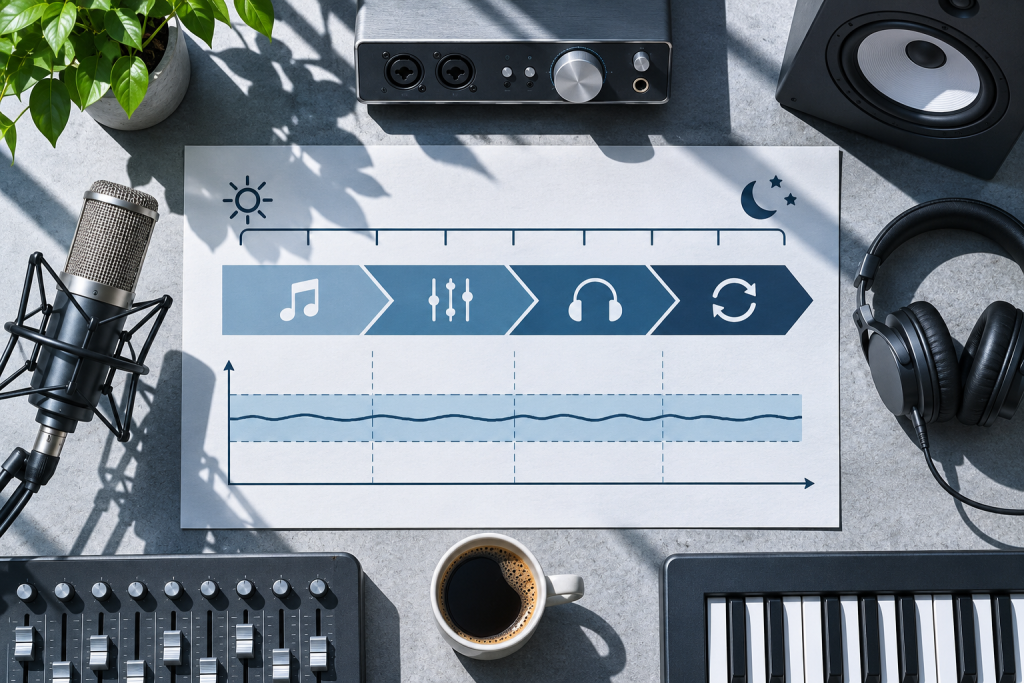
The problem with overnight rotation isn’t any single track. It’s the drift. A show that opens at 18:00 and closes at 06:00 passes through at least three listener contexts: the commute home, the late-evening background slot, the small hours when the only people still listening are the ones who care most. Level shifts that would be invisible inside a two-hour mix become obvious across twelve.
We ran a station for years before we ever opened a mastering chain, and the habit that stuck was judging a set by whether it held together over two hours. Overnight is the same test stretched further. Here’s how we keep a twelve-hour rotation steady without touching it every night.
The rotation is a mastering problem before it is a scheduling problem
If two tracks in the same hour differ by more than a couple of LU, the listener hears a jump, not a transition. No amount of playlist sequencing fixes that; the material has to be levelled before it ever reaches the automation.
This is the tedious, mechanical part of level-matching and it is also the part where automation genuinely outperforms a tired human being. Matching twelve tracks so none of them lunges out of the speakers is dull work, and dull work at four in the morning gets done badly. Use the tools for it. Set a loudness target, run the batch, and accept that the machine will do the boring half of the job faster and more consistently than you will.
What it cannot do is decide which element should lose the argument in a dense chorus, or tell you that the vocal vanishing at 2 kHz is a reason the song exists. Turning up a whole band to fix a buried vocal just makes the cymbals harsh. That is a judgement about the music and it stays with you.
Where the target actually sits
Streaming normalisation means most of your overnight listeners are hearing your output through a platform that will pull loud material down anyway. Pop masters in the current market average around -8 LUFS perceived, which is loud, and volume for its own sake no longer buys anything when the platform is going to normalise it.
The rule we settled on: master to a single target across the whole rotation, and pick that target slightly below whatever your loudest reference track does. A uniform -12 to -10 LUFS integrated across the library will normalise down cleanly and up acceptably, and it keeps the quiet tracks quiet instead of forcing them into a fight they can’t win. If a track only survives when it’s four dB hotter than its neighbours, the mastering is covering for a mix problem.
Deal with transient peaks before they reach the limiter
A clipper shaving two to four dB off the transients lets the limiter work less hard, and a limiter that isn’t slammed introduces less pumping and distortion. Pair that with modest gain reduction, three or four dB on the limiter rather than six or eight, and switch on true peak limiting so the spaces between samples stay clean on a phone speaker.
Two limiters splitting the work is a legitimate approach; several engineers use it deliberately to get the character of both without either one working overtime. We’ve done it on drum-heavy material overnight and left sparse acoustic tracks alone. Lighter songs need lighter limiting, and a little pumping on a rock track is not the same crime it is on a ballad.
Keep an eye on output gain. Several of the saturation and enhancer stages in a typical chain will raise amplitude enough to clip downstream if you leave them unattended.
Build the overnight block as three arcs, not one flat line
Twelve hours of identical loudness is its own kind of fatigue. What holds a listener through the small hours is gradual movement, and the movement should be in density rather than level.
- 18:00 to 22:00. Peak listening. The loudest, densest material of the rotation belongs here, because that’s when people are choosing to be there rather than leaving it on.
- 22:00 to 02:00. Pull the average down by a decibel or so by sequence rather than processing. Fewer wall-of-guitar tracks per hour.
- 02:00 to 06:00. The loyal handful. Density drops, transient content drops, and the integrated level can come down another dB. Nothing gets re-mastered; the tracks simply sit in a gentler order.
The trick is that the loudness target never changes. Only the material sitting in each slot changes. This is the difference between programming a station and shuffling a folder.
Meter the whole show, not the track
We check rotation loudness with a short-term window of a few seconds and an integrated figure across the hour, plus a true-peak ceiling logged continuously. If the hourly integrated figure wanders more than 1.5 LU from the target, something got through that shouldn’t have, usually a track mastered years ago to an entirely different convention and dropped in without checking.
A reference track is still the compass. Pick several, and pick them from the last couple of years, because loudness conventions move. Compare your hourly average against them rather than against a number in a spec sheet.
Things that quietly break the levels after you’ve fixed them
Ad breaks, station idents and jingles are mastered for impact and will push your hourly average up every single time they land. Process them separately to the same integrated target as the music and check the join, because a jingle four dB hotter than the track either side of it is the fastest way to make a rotation sound amateur.
Crossfades matter too. A long fade between two tracks at different densities can read as a level dip even when both are correctly mastered. Shorten the crossfade on adjacent tracks with a big dynamic difference, or accept a little overlap.
And check what your playout system does to gain. Some apply their own normalisation on top of your mastering, which means your carefully levelled library arrives at the encoder twice-processed. Turn one of them off. Ours runs flat and trusts the files.
The rotation doesn’t need to sound the same at every hour. It needs to sound like the same station at every hour, which is a different and more achievable goal. Master to one target, sequence for density, meter the hour, and let the machine do the level-matching while you make the calls it can’t.