November 15, 2026
Checking a Master Across Six Playback Systems Before It Leaves the Studio
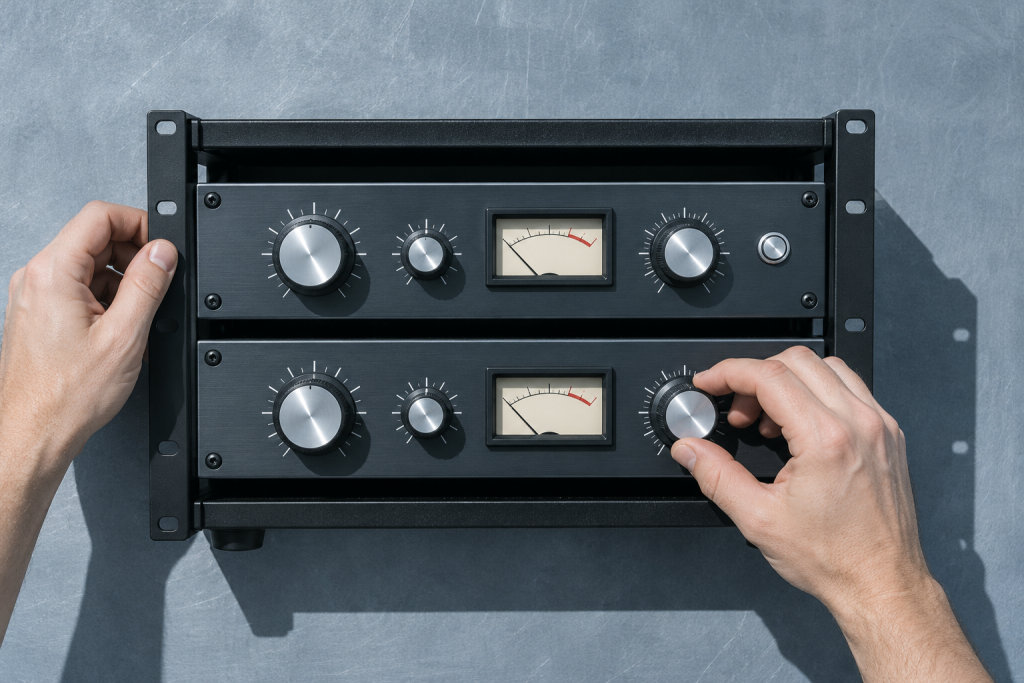
Six systems is the number we settled on after too many masters left here sounding finished and arrived on a phone sounding thin. Not because six is magic; because each one answers a different question, and skipping any of them means guessing at an answer you could have heard.
Translation is one of the three jobs of mastering, alongside loudness and tone, and it is the one that gets the least attention until a track fails somewhere public. The mix should already sound professional before any of this; if a problem is structural, no amount of checking on six systems will fix it, and you should send it back to the mix. What follows is the pass we actually run, in order, with what each system is there to catch.
Start with the worst speaker you own
A single small mono driver, ideally something with a three inch cone and no bass response at all. This is not a nostalgia exercise. It is the fastest way to hear whether the vocal and the snare survive when the low end disappears.
Play the loudest chorus first, not the intro. Intros flatter everything. If the chorus collapses into a midrange smear on a tiny speaker, the balance is being carried by sub information that most listeners will never reproduce. That is a mix decision nine times out of ten, but occasionally it is a master that leaned too hard on low shelf.
Keep this check mono. A small speaker is already summing everything into one point; feeding it stereo just hides the problem.
Laptop speakers, sitting where a person actually sits
Different failure mode entirely. Laptop drivers have a narrow band of competence and a resonant upper midrange that will expose harshness you stopped hearing on your monitors hours ago. Sit at normal distance, not with your ear at the grille.
What we listen for here is fatigue. Does the second chorus make you want to turn it down? Saturation and stereo widening are the usual suspects; both are finishing touches that go wrong quietly, and a widened image that sounds expansive on a treated pair can turn glassy on a laptop. If the answer is yes, back the widening off before you touch anything else.
Headphones, but only one pair, and only for detail
Headphones are where you hear edits, clicks, breaths, and the seam between sections. They are a poor judge of low end balance and a worse judge of stereo image, because nothing is crossfeeding between your ears. Use them to confirm cleanliness, not to make tonal decisions.
One caveat we have learned the slow way: if a master only works on headphones, it does not work. Headphone playback hides phase problems that a pair of speakers in a room will reveal immediately.
The car, which is the real test
Nobody wants to hear it, but the car is where a large share of listening happens, and it is a genuinely hostile acoustic space: a small enclosed box with reflective glass on one side, absorbent fabric on the other, and a low frequency response that peaks somewhere unpredictable depending on where the driver sits. A master that translates in a car will usually translate anywhere.
Burn a disc or use a lossless file on a USB stick rather than streaming from a phone over Bluetooth. Bluetooth adds its own codec stage and you will spend an hour chasing an artifact that lives in the transport, not the master. Listen at a normal volume for at least a full song, then once louder. The louder pass tells you whether the limiter is working too hard: if the choruses feel flatter than the verses, the gain reduction is eating your dynamics and you should pull the ceiling down rather than push the input up.
Two references, not one
A single reference track will lead you into copying it. Pick several instead, and pick them for different reasons: one for the low end, one for the vocal presence, one for overall loudness and density. Listen to the references on the same system, in the same session, at matched loudness. If you have to change the volume between your track and the reference to compare them fairly, you are not comparing tone any more, you are comparing level.
Choose them before you start work. Discovering halfway through that the reference does not resemble the sound you want means starting the tonal decisions again from zero.
Phone speaker, at arm’s length
Different from the small monitor because it is usually held in a hand, pointed roughly at a face, at a distance of a foot or two. It is the least forgiving playback path in common use and it is also the one where most casual listening happens.
Do not try to make the track sound good here. Try to confirm it still makes sense. Can you follow the vocal line? Does the kick still imply a pulse when its fundamental is gone? If the arrangement depends entirely on information below 200 Hz, this check will tell you plainly, and it is better to know before release than after.
Back to the main monitors, loudness matched
The last pass happens where you started, and its job is compliance rather than tone. Check true peak, check integrated loudness against whatever target the delivery requires, and check that the loudest moment is not clipping the converter on the way out. This is the part measurement does better than ears: a true peak overshoot is precisely the kind of thing a listener will not hear until it is a distortion complaint.
Measure, then listen once more with the meters closed. If the two disagree, trust the ears on tone and the meters on compliance.
What the six-system pass will not do
It will not rescue a mix with a buried vocal or a low midrange that is genuinely too loud. Pushing a master to compensate for either produces a track that is louder and still wrong, and the problems become easier to hear rather than harder. Fix those upstream.
It also will not tell you whether the song is good. That question is settled long before the master, and no amount of checking on six systems changes the answer. What the pass buys you is confidence that the translation holds, so that when someone hears the track for the first time on a kitchen speaker at a party, they hear the song and not the room.
Run the six in the same order every time. The value is not in the individual checks, it is in the repetition: after a dozen masters you stop noticing the systems and start noticing the track, and the problems announce themselves before you have finished the first chorus.